


Save 95% of energy costs by using rohde solarready

Fire Smarter. Spend Less.
Running an electric kiln is one of the biggest energy costs in any home or studio—making solar a major opportunity for long-term savings, similar to the benefits of powering an electric vehicle or heat pump. By using the energy your own system produces, you can significantly reduce firing costs year-round, even in winter or overcast conditions.
Solar-Compatible Control System
ROHDE kilns can be easily integrated into a solar-powered workflow with the right controller setup. Below is a quick overview of how SolarReady firing works and what you need to get started.

COMPATIBILITY
Works with any ROHDE kiln built in 1994 or later when using a solar-optimized control system.

CONTROLLERS
TR 511 and TR 532 support both conventional firing and SolarReady mode.

FLEXIBILITY
Easily switch between modes to fire traditionally or maximize solar energy.
Monitor SolarReady firing through the MyKiln App
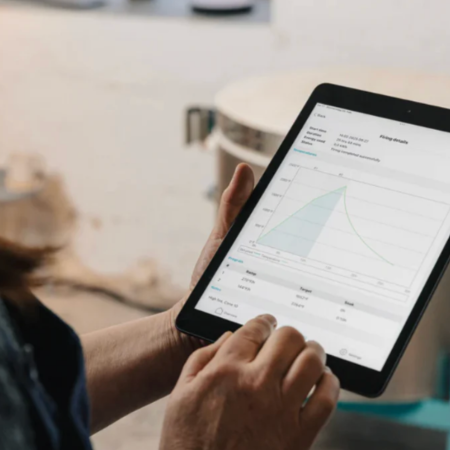
ROHDE MYKILN APP FEATURES
Real-Time Monitoring
Track your kiln’s firing progress from anywhere—see live temperature, program status, and alerts right on your phone.
Remote Program Control
Create, edit, and send firing programs directly from the app, giving you flexibility without needing to be at the kiln.
Solar Savings Insights
See exactly how much solar energy your kiln used during each firing, helping you understand—and maximize—your cost and energy savings.
Built for Modern ROHDE Controllers
The MyKiln App works seamlessly with ROHDE’s latest controllers, giving you advanced digital control, SolarReady operation, and an easy way to explore the full range of controller features.
Firing ceramics with solar power
Questions from ceramicists
The actual savings depend on the electricity price, the size of the kiln, the type of firing and the output of your PV system.
If the PV system and kiln are well coordinated, the proportion of self-generated electricity is up to 95%. Your savings on electricity costs are correspondingly high.
Examples from practice:
Firing in sunny weather:
- Date: April 27
- Location: Southern California
- 94% solar-powered firing
- Smooth, uninterrupted firing
- Target temperature: 2,318°F
Firing details:
- Start: 8:48 a.m.
- Target: 2,318°F
- Ramp rate: 315°F/hr
- Hold time: 10 minutes
- End of firing: approx. 4:59 p.m. (total firing time: ~8 hours 11 minutes)
- Grid electricity used: approx. 6%
- Weather: ~45–64°F, clear skies, full sun
Firing in Overcast Weather:
- Date: November 18
- Location: Pacific Northwest, USA
- 24% solar-powered firing
- Glaze firing
- Target temperature: 2,309°F
Firing details:
- Start: 9:00 a.m.
- Target: 2,309°F
- Ramp rate: 297°F/hr
- Hold time: 20 minutes
- End of firing: approx. 5:50 p.m. (total firing time: ~8 hours 50 minutes)
- Grid electricity used: approx. 76%
- Weather: ~41–46°F, overcast and cloudy, brief sun around 12:30 p.m.
A ceramic kiln controls the temperature by switching the heating elements on and off. With conventional control systems, this works so quickly that a photovoltaics system is overwhelmed by the speed.
With a photovoltaics-optimized control system, these switching cycles are extended so that they harmonize with your PV system.
Both controllers (TR 511 and TR 532) can be switched between conventional firing and photovoltaics-optimized.
At the beginning of the firing process and in the low temperature ranges, the firing curve is still noticeably wavy compared to the smooth target curve. This changes long before the temperature ranges relevant for the ceramic quality (quartz inversion) are reached.
Before the market launch, we tested photovoltaics-optimized firing intensively in practice for a year in our own laboratory and in some ceramic companies: there are no differences in terms of the results.
Current PV systems are grid-connected. This means that the kiln is still connected to the electricity grid in the house. If sufficient electricity is available from the PV system, this is used as a priority and less electricity is drawn from the grid. If no or too little electricity is available from the PV system, the electricity comes from the grid as before.
There is no interruption in the power supply. Not even with ceramic firing.
As a rule of thumb, the so-called peak output of your photovoltaics system should be 2.5 times the connected load of your kiln.
This means that an Ecotop 60 is the right size for 9.9 kW photovoltaics systems. A TE 200 S would be a perfect combination for the larger 20 kW photovoltaics systems – especially those used in combination with a wallbox.